
The Low Save Mindset: When 100m AGL Becomes Your Starting Line
The 89-Meter Decision: When Everything Changes
There I was, staring at my altimeter reading 89 meters above ground level, circling over what looked like a perfectly landable field. In that moment, every fiber of my pilot training screamed "landing pattern!" But something else whispered "not yet." That whisper turned into one of the most memorable saves of my flying career, and it fundamentally changed how I approach critically low altitudes.
Most of us have been conditioned to think of 100 meters as the magic number—the altitude where we transition from "still flying" to "preparing to land." But what if we've been thinking about this all wrong? What if 100 meters isn't the end of your flight, but potentially just the beginning of your best thermal climb of the day?
Reframing the Low Game
The low save mindset isn't about being reckless or ignoring safety protocols. It's about making calculated decisions based on specific environmental factors rather than arbitrary altitude numbers. When you're low, your brain wants to default to survival mode, but the pilots who consistently extend their flights have learned to stay in opportunity mode just a little bit longer.
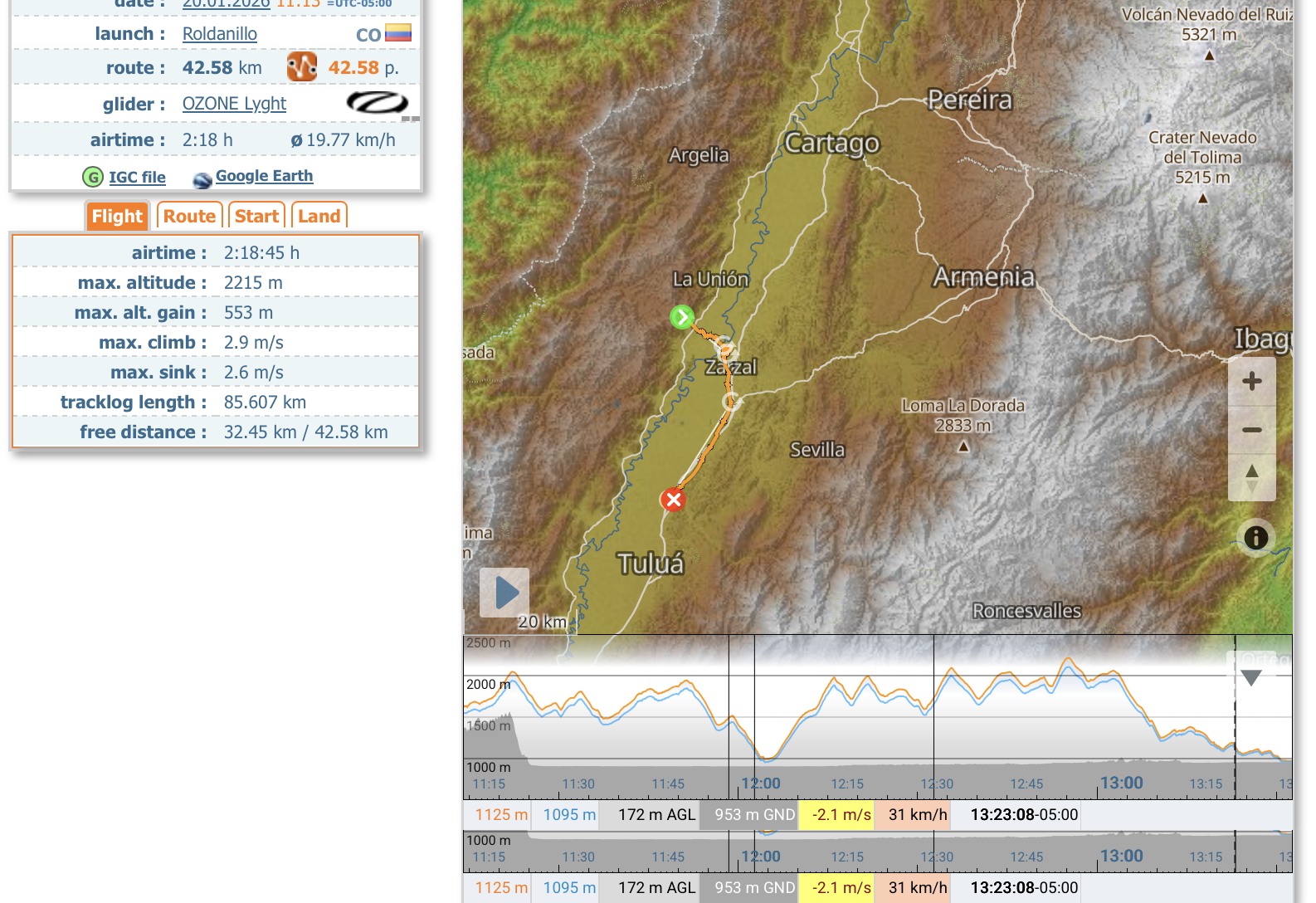
That day over the Colombian countryside, four key factors aligned to make my decision to continue searching worthwhile, rather than setting up for landing immediately.
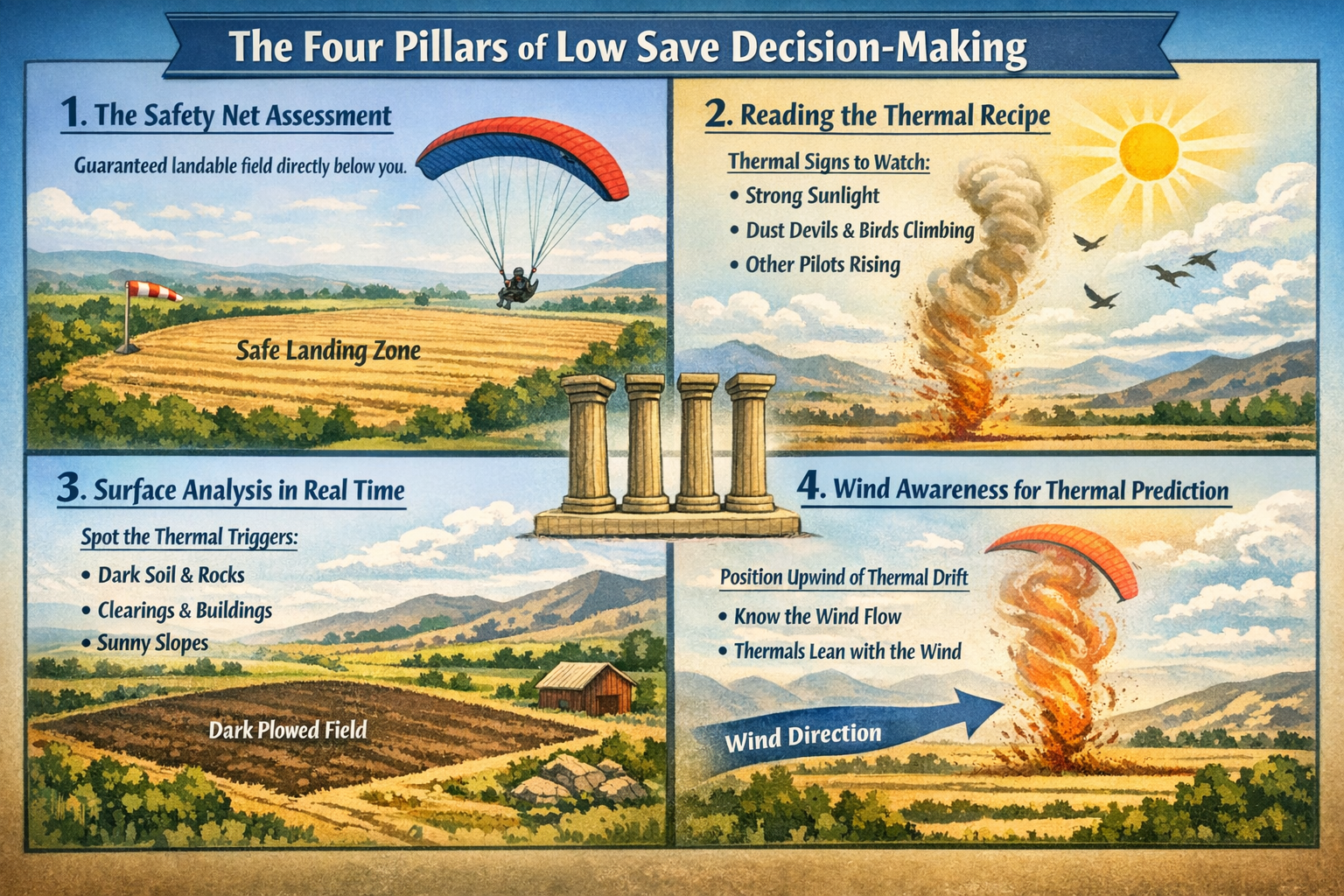
The Four Pillars of Low Save Decision-Making
1. The Safety Net Assessment
The foundation of any low save attempt is having an unquestionably landable field directly beneath you. Not "probably okay" or "might work"—absolutely, positively landable. In my case, the field was large, flat, recently harvested, and had clear approach paths from multiple directions. This wasn't about being optimistic about a marginal field; it was about having complete confidence that if the thermal search failed, I had an easy out.
Your safety net must be binary: either you have a guaranteed landing option right below you, or you don't. If there's any doubt, head for better terrain immediately.
2. Reading the Thermal Recipe
Colombia's intense sun was painting the landscape with thermal potential. Strong solar heating, especially in tropical regions, creates predictable lift patterns throughout the day. The key was recognizing that the atmospheric conditions were actively producing thermals, not just that it was "a nice day."
Look for these thermal indicators when you're low:
Strong, direct sunlight hitting the ground
Minimal cloud cover blocking solar heating
Time of day in the thermal window (typically 11 AM to 4 PM)
Other pilots climbing nearby or on radio reports
Visual signs like dust devils or birds thermaling
3. Surface Analysis in Real Time
The recently harvested field beneath me was darker than the surrounding green pastures—a crucial detail that significantly increased the likelihood of thermal generation. Dark surfaces absorb more heat and release it as rising air more readily than light-colored or vegetated areas.
From low altitude, you can actually see the thermal triggers:
Freshly plowed dark soil
Rocky outcroppings
Parking lots or buildings
Areas where vegetation has been cleared
South-facing slopes getting direct sun
4. Wind Awareness for Thermal Prediction
Having a solid read on wind direction allowed me to position myself on the upwind side of the field's thermal triggers. Thermals don't rise straight up—they lean with the wind, and understanding this drift is critical when you're working close to the ground.
At low altitude, wind awareness becomes even more crucial because you're dealing with mechanical turbulence and thermal shear in compressed airspace. Know where the wind is coming from, how strong it is, and how it's interacting with the terrain features below you.
Managing the Elevated Risk Profile
Let's be crystal clear: flying low inherently carries increased risk. When you're at 89 meters instead of 1,500 meters, everything happens faster and your margin for error shrinks dramatically.
The Low Altitude Risk Factors
Increased turbulence: You're in the mechanical turbulence zone created by terrain features, buildings, and vegetation. Your wing will work harder, and you need to be more active with your inputs.
Compressed decision time: At 100 meters, you have seconds to react to changing conditions, not minutes. Your decision-making process must be accelerated without becoming hasty.
Less room for sloppy technique: Every turn must be precise. There's no altitude to trade for speed if you get slow in a turn, and no room to recover from a significant altitude loss.
Limited escape options: Once you commit to a low save attempt, your options become increasingly limited with each passing second.
The Mental Shift That Changes Everything
The breakthrough moment in low save flying comes when you can maintain calm analytical thinking despite your brain's alarm bells. This requires practice, experience, and most importantly, honest self-assessment of your skills and the specific situation.
Start building this mindset on higher saves—at 300 or 500 meters—where you have more room for error. Practice staying in search mode longer than feels comfortable, but always with that guaranteed landable field beneath you.
When 89 Meters Becomes 1,500 Meters
That day, my decision to trust the thermal signs and continue searching paid off with a climb to cloudbase and eventually a 45-kilometer flight to goal. But more importantly, it reinforced that our predetermined altitude limits are often more psychological than practical.
The next time you find yourself looking at double digits on your altimeter, remember: you're not necessarily out of options. You might just be at the starting line of your most memorable flight. The key is knowing when to take that calculated risk and when to prioritize the guaranteed landing. That judgment—that's what separates the pilots who occasionally get lucky from those who consistently extend their flights and push their personal boundaries safely.
The low save mindset isn't about ignoring altitude—it's about making altitude work for you instead of against you.