

Techniques for Faster, More Efficient Climbs
If your first climb is slow, your whole XC day pays the price.
This guide gives you a simple, repeatable way to enter thermals faster, stabilize sooner, and center tighter—so your exits are higher and your transitions safer. Think of it as a 4-step loop you can run all day.
What a “clean entry” actually is
A clean entry is Detect → Test → Commit → Center with minimal hesitation and minimal altitude loss. Done right, the wing feels quiet and loaded, your circle stays stable, and the vario averages up within 10–15 seconds.
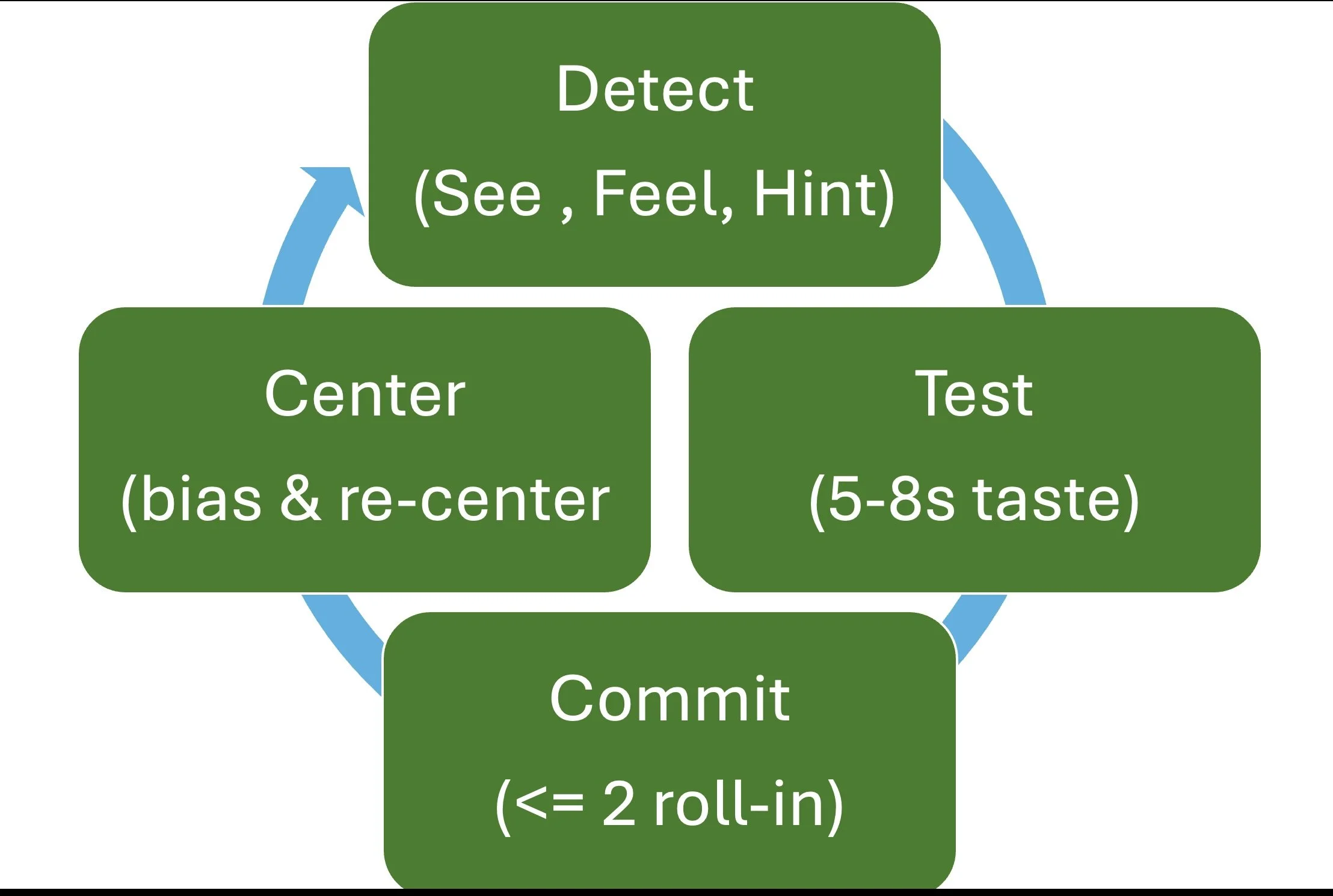
The 4-step Thermal Entry Loop (with windward logic baked in)
1) Detect (see + feel + hint)
-
Visuals: sun–shade boundary, birds, dust/smoke drift, other pilots climbing, fresh sun on trigger terrain.
-
Wing feel: a smooth surge, light yaw toward lift, tip going light/heavy.
-
Vario hint: faint beeps or a rising averager—don’t wait for a full chorus.
2) Test (taste without wasting)
-
Take a 5–8 s “taste”: small S-turn or a gentle 90–120° arc across the trigger.
-
If you get ~5 clean beeps, you’ve got structure. Mark the bite and clock the drift direction.
3) Commit (decisive, coordinated)
-
Roll in within ~2 s; choose a turn direction that keeps the upwind quadrant through the bite and fits traffic.
-
Target 25–35° bank, coordinated with inside brake + weight shift; manage pitch with the outside hand.
-
Fly trim to slight-braked; avoid over-brake so speed carries you into the core.
4) Center (tighten the candy)
-
Add a subtle windward bias each 360 (translate 3–5 m upwind).
-
If lift weakens on one side, use the 90° step re-center (below).
-
Leave the climb when it decays to ~80% of peak—trade stale lift for time on the next trigger.
Lock the Core, Fix the Circle, Save the Day
Once you’ve committed, every circle asks the same question: stay, adjust, or go? In wind, the right answer starts with a subtle upwind bias so you don’t drift out the back. If your beeps are stronger on one side, the 90° step re-center moves your circle into the core in one or two laps. If climb rate or altitude margin won’t meet plan, bail early toward your next trigger—aligned with your arrival floor and decision gates. Here’s how to run that sequence with confidence.
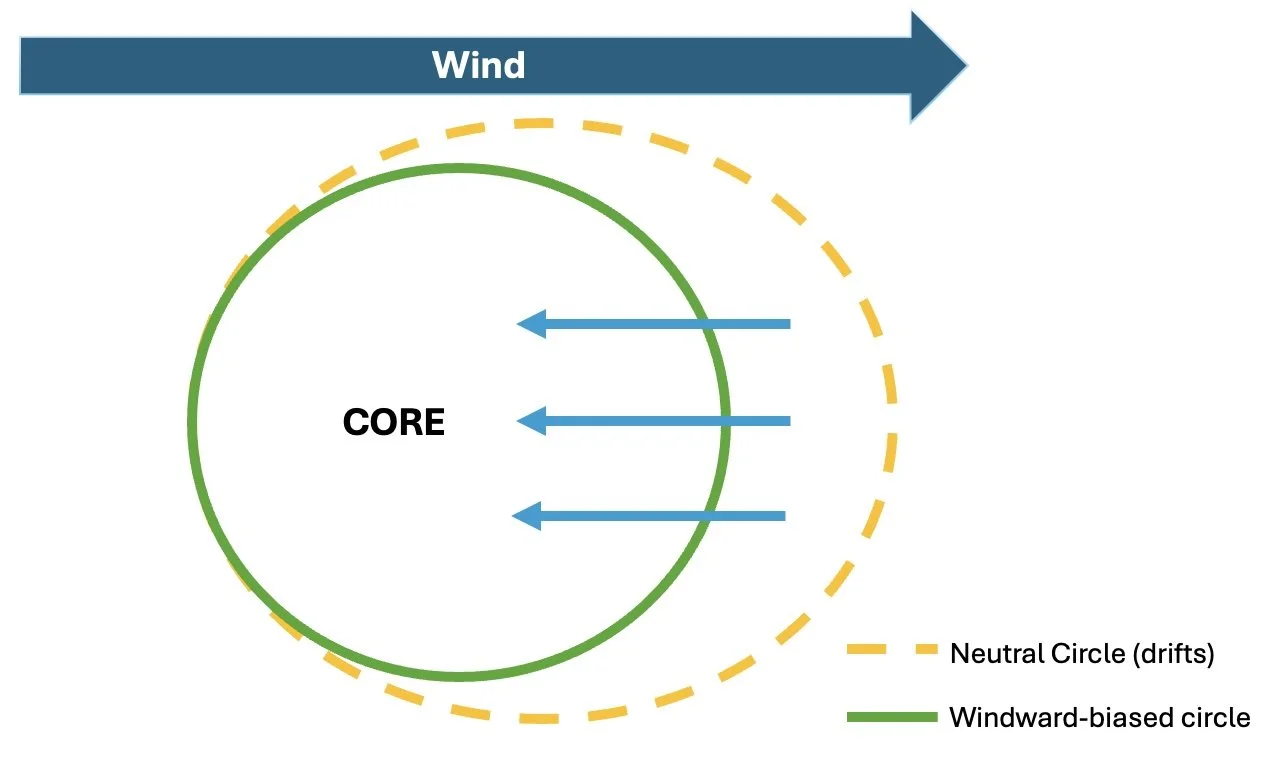
Windward Bias—Why it matters and how to use it
What it is: In wind or valley breeze, thermals lean downwind. The stronger, “feeder” side is upwind. Windward bias means gently shifting your circle a few meters into the wind every 360 so you stay attached to the feeder side and don’t spiral out the back.
How to read it (fast):
-
Watch groundspeed around the circle: slower on the upwind arc, faster on the downwind arc.
-
Note drift during your taste/commit: if your circle center marches downwind, you’re on a leaning column.
-
Look for smoke/dust/birds and other pilots’ drift to confirm.
How to apply it:
-
Enter so that your upwind quadrant passes through the best bite.
-
Each lap, translate 3–5 m upwind (more if breeze is strong).
-
Keep exits upwind of the spine/ridge to avoid lee traps.
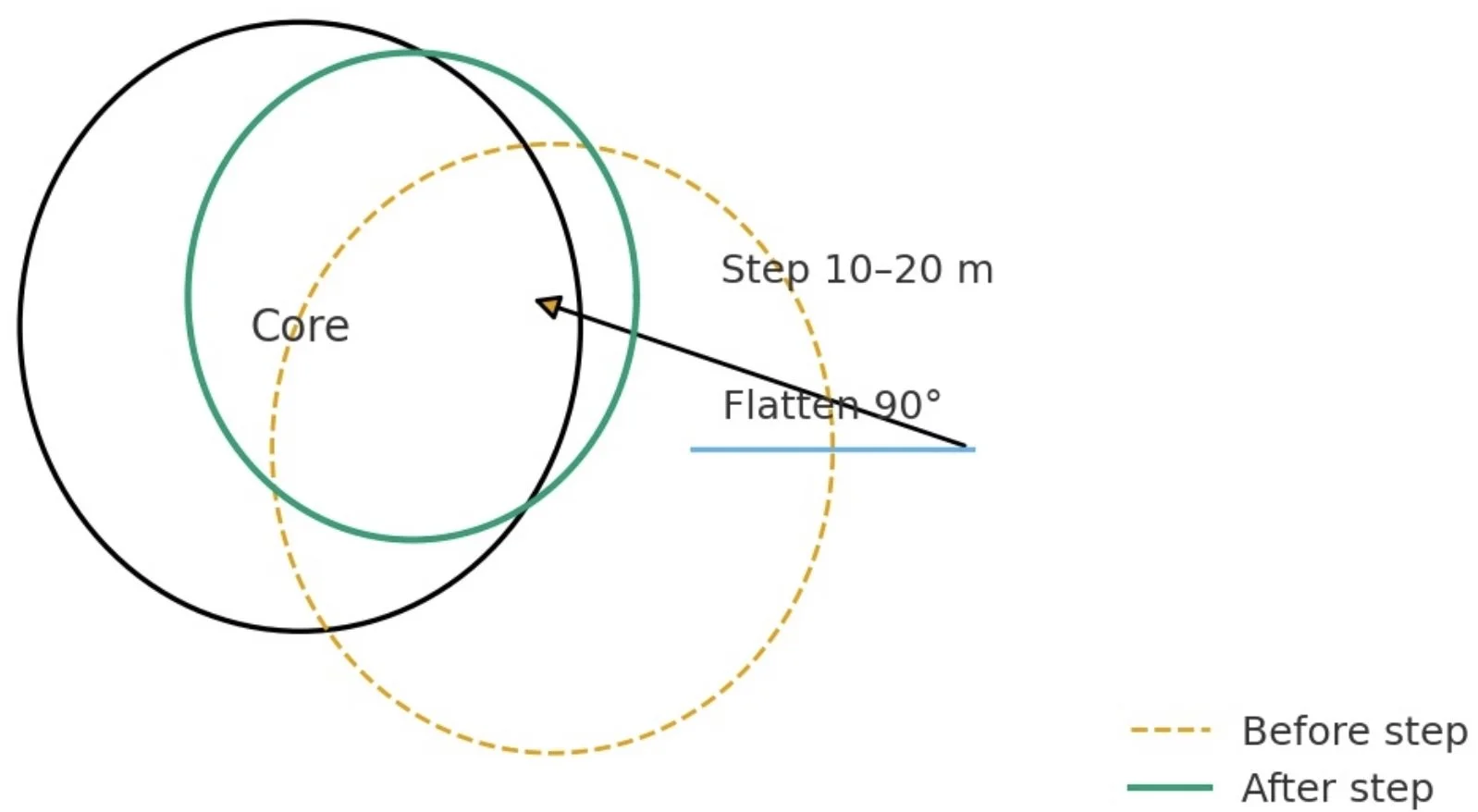
90° Step Re-Center — What it shows & how to use it
What the elements mean
-
Core (solid circle): strongest lift.
-
Before step (dashed): your circle clips the edge—average climb is weak.
-
Flatten 90°: briefly reduce bank for ~90° of arc (1–2 s) to enable translation.
-
Step 10–20 m (arrow): glide straight toward the quadrant with cleanest beeps last lap—aim slightly upwind in leaning thermals.
-
After step (green): retighten; your new circle overlaps the core more, so average vario rises.
Deeper logic (how far, how long, why it works)
-
How far: with a typical XC radius 15–22 m (25–35° bank), step 10–15 m in normal lift; up to 20 m in strong/leaning cores. If no improvement next lap, halve the distance and try again.
-
How long: at trim, 10 m ≈ 1 s, 20 m ≈ 2 s. Keep the flatten short; retighten quickly.
-
Control priorities: manage pitch with the outside hand, roll back decisively to your bank, and keep windward bias every 360.
-
Stop rule: give yourself two step attempts. If stabilized climb doesn’t improve by ≥ +0.2 m/s, accept “good enough” or bail.
-
Why it works: flattening lets you cross the lift gradient; translating re-centers your circle on the rising column—often worth +0.3–0.8 m/s vs staying off-center.
When to use it
-
One side of the circle is clearly stronger, or drift is carrying you downwind out the back. Ensure traffic clearancebefore stepping.
Common mistakes (and fixes)
-
Over-stepping past core → shorten to 5–10 m.
-
Flattening too long → keep it 1–2 s.
-
Chasing turbulence → step toward stable, sustained beeps.
-
Forgetting windward bias → translate into wind every lap.
Safety + etiquette
-
Traffic: match direction; don’t cut through a gaggle—step when clear or outward first.
-
Terrain: never step lee-side near the hill; respect your hard deck.
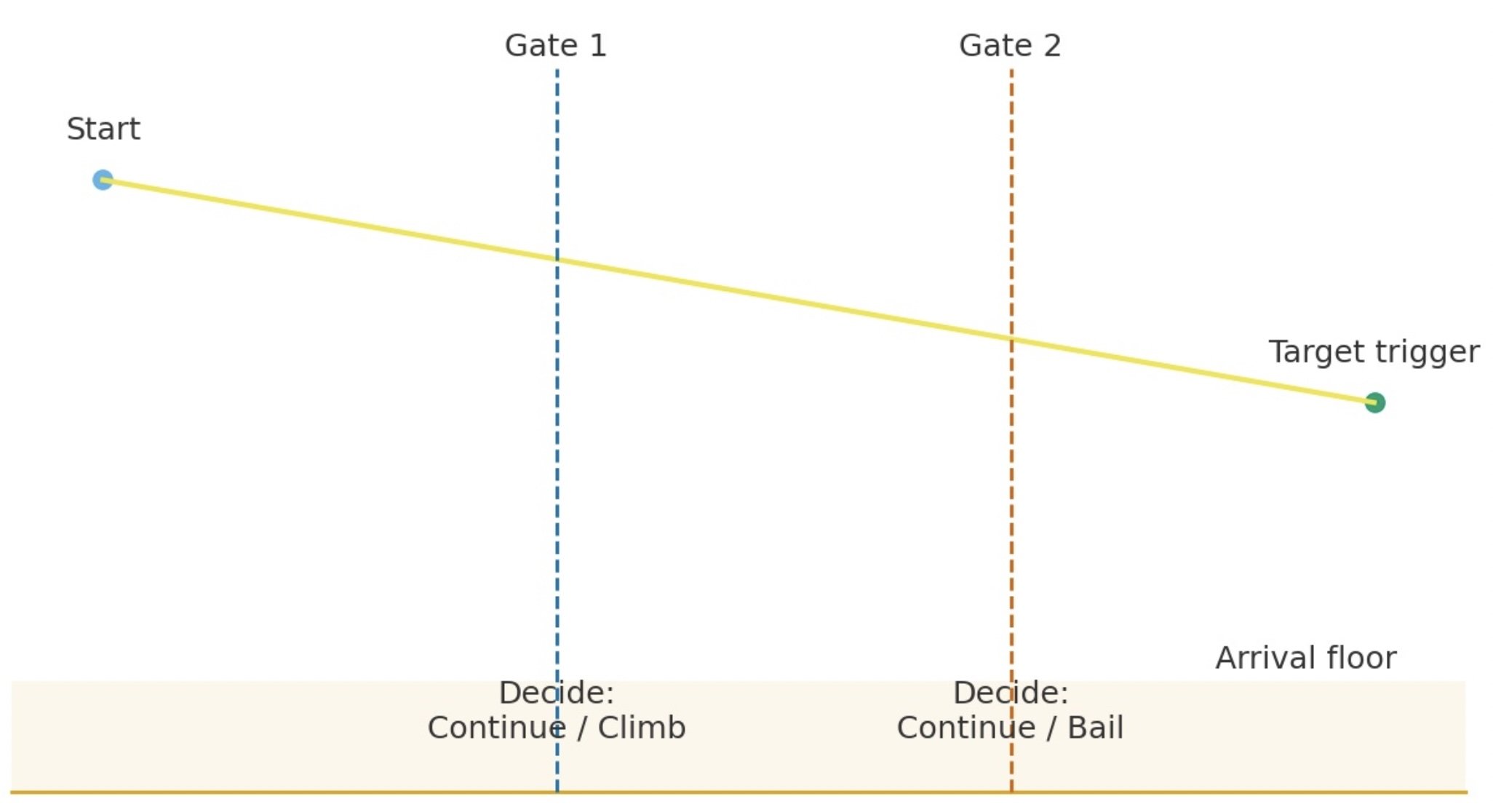
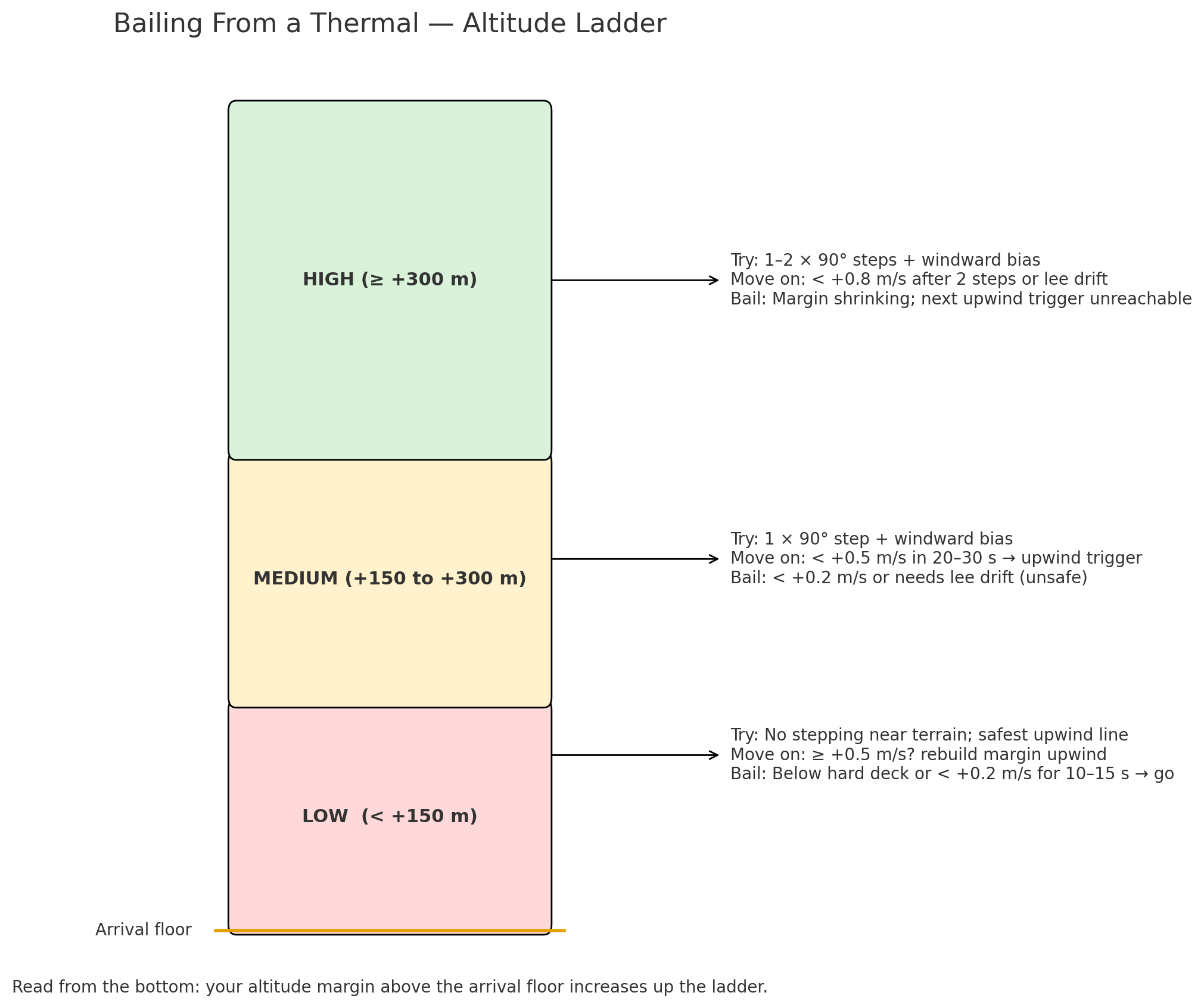
Bailing from a thermal: decisions by altitude band (relative to your arrival floor)
Definitions
-
Arrival floor: the minimum AGL you’ve committed to reach your next terrain/edge/LZ (e.g., ≥200 m valley edges; ≥300 m unknown LZs).
-
Margin: current AGL minus your arrival floor.
Rule of three (fast filter)
-
3 tastes without 5 clean beeps → go.
-
3 laps without stabilized +0.5 m/s (medium band) → go.
-
3 re-centers without +0.2 m/s improvement → go.
What “bail” actually means
-
Turn cross- or upwind toward the next sun-exposed trigger or your safety line—not downwind/lee.
-
Choose a visible, timed target (light–dark fence, birds, dust, another pilot, a heating facet).
-
Guard your arrival floor; if erosion continues, commit early to Plan B LZ while you have options.
Examples (put numbers on it)
-
Medium band: arrival floor to ridge 200 m. You’re at 320 m AGL (+120 m) averaging +0.3 m/s after one step. If nearby air looks active, move on upwind; if not, accept the weak climb only if you remain windward-safe.
-
Low band: arrival floor to LZ 300 m. You’re at 360 m AGL (+60 m) with +0.1–0.2 m/s and drifting lee. That’s a bail—turn cross/upwind, protect the floor, re-engage at a safer trigger.
Tie it to your gates
On every transition, set two decision gates. At Gate 1 decide Continue/Climb. At Gate 2, if margin is slipping toward the floor or climb < +0.5 m/s (day-dependent), Bail upwind without hesitation.
Playbook by day type
Light, wide thermals (blue starts)
-
Shallow bank, larger circle; prioritize smoothness over chasing spikes. Patience pays.
Strong, tight cores (cumulus popping)
-
Bank up to 35–45° if your wing/skills allow; manage pitch with small, quick inputs. Expect sharper surges.
Windy / active valley breeze
-
Thermals lean and drift; work the windward side, translate upwind each lap, and keep exits upwind of the spine. Expect your circle center to march downwind—correct every turn.
Crowded gaggles
-
Match direction and match bank. Fly a steady circle; no figure-eights inside the gaggle.
Common Thermaling mistakes (and fixes)
-
Hunting for perfection: you keep sampling forever. → Commit after 5 clean beeps.
-
Over-braking on entry: wing wallows, vario lies. → Ease inside hand 2–3 cm; let speed carry you.
-
Staying downwind in wind: spiraling out the back. → Apply windward bias every 360; use the 90° step.
-
Milking dead air: late, low exits. → Leave at ≥80% of peak and find fresh energy.
-
Turning-direction chaos (traffic): → Match the gaggle; hold line; pass wide, not through.
60-second Pre-Entry Script (say it before you launch) – Thermal Plan
-
Trigger plan: “I’ll test the light–dark line and the birds over the shoulder.”
-
Commit rule: “Five clean beeps = roll-in now (≤2 s). Target 25–35° bank.”
-
Re-center rule: “Flatten 90°, step 10–20 m upwind toward the strongest bite, retighten.”
-
Exit rule: “Leave at ≥80% of peak; next trigger ready.”
Thermaling drills that move the needle
-
Five-Beep Commit: on your first lift, commit on cue—no extra S-turns.
-
90° Step Re-center (×3): in one climb, perform three deliberate steps toward strongest lift, aiming slightly upwind.
-
Bank-Window Discipline: pick a window (e.g., 25–35°) and keep entries within it all flight.
-
Windward Ladder: over four circles, translate 5–10 m upwind each lap; check if exit height improves.
Metrics to track (fast, objective)
-
Time-to-core: seconds from first clean beep to stable ≥ +1.0 m/s.
-
Entry loss (m): altitude lost from first beep to stable climb.
-
Stabilized climb rate: 15–30 s average after commit.
-
Circles-to-center: laps it takes to hit max vario.
Write one number per flight—you’ll see your 1% gains.
Vario / app setup (so audio helps, not hurts)
-
Audio threshold: set positive beep low (e.g., +0.1 to +0.2 m/s) to hear structure early.
-
Integration/smoothing: moderate, so “five clean beeps” are discernible.
-
Averager tone: enable; it rewards steadiness.
-
XCTrack / Flyskyhy tip: create a “Thermal” profile with louder positive beeps and muted sink to focus on entry.
Safety guardrails (non-negotiable)
-
No lee-side experiments near terrain; if drift turns lee, bail early.
-
Right-of-way: match thermal direction; keep vertical/horizontal separation; announce changes.
-
Low-height rules: set a hard deck (e.g., 150 m AGL near terrain; 200–300 m over flat unknowns). Below it, stop probing and commit to the safest glide.
Debrief in two minutes
-
Screenshot one entry and one re-center; annotate trigger, drift/wind read, and time-to-core. (Guided Flight Analysis: How to Review Your Paragliding XC Track Using XContest)
-
Write Best decision / One fix. Turn the fix into tomorrow’s Two Goals (baseline + stretch).
Related Skyout reads
-
Guided Flight Analysis: How to Review Your Paragliding XC Track Using XContest → https://www.skyoutpg.com/skyout-insights/guided-flight-analysis-how-to-review-your-paragliding-xc-track-using-xcontest
-
Read the Ridge Shadows (Quick Snap) → https://www.skyoutpg.com/skyout-insights/skyout-quick-snap-read-the-ridge-shadows
-
Two Goals, One Flight (Quick Snap) → https://www.skyoutpg.com/skyout-insights/skyout-quick-snap-two-goals-one-flight
Ready to get coached on this in the air and in debrief?
-
See Skyout tours & coaching → https://www.skyoutpg.com/our-tours
-
Core Line: Colombia with the Pros (Feb 1–9) → https://www.skyoutpg.com/core-line-paragliding-pros-colombia